
Our Modules
operateMybox is built as a modular platform. Each module addresses a specific area of logistics operations but integrates seamlessly with the others. Switch between the modules below to explore features available today and future implementations.
Discover Our Modules

TOS – Terminal Operating System
Coordinates vessel, berth, and yard planning as well as terminal master data, enabling efficient terminal operations through realtime scheduling and resource management.
- Vessel planning
- Berth planning
- Yard-management
- Terminal Masterdata

GOS – Gate Operating System
Manages all gate-related activities, from automated video recognition (CAMCO) to IN/OUT processing, pre/post-transfer handling, and API-based digitalization—ensuring smooth, automated container gate workflows.
- Automated video recognition (CAMCO)
- In/Out container processing
- Pre-/Post-transfer handling
- API-based integration with partner systems
Smart gates for smart terminals.
One gate standard for every terminal.
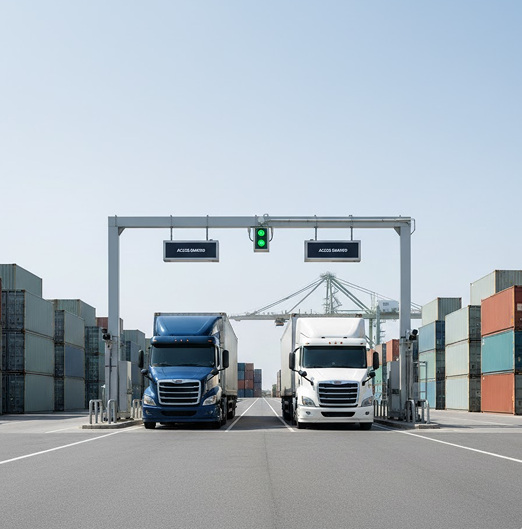
With operateMybox GOS, terminal gate processes become fully digital, secure, and standardized — from truck arrival and identification to container handover and departure.
Built as a cloud-ready module, GOS connects every stakeholder: truckers, dispatchers, and terminal staff including containers, equipment and operators.
Overview
operateMybox GOS is the digital gate control system for container terminals within the operateMybox ecosystem.
It manages all in- and outbound truck movements, coordinates slot bookings, ensures secure container handover through digital release rights, and synchronizes operational data with the terminal’s TOS.
Core Capabilities
Digital Truck Flow Management — from entry to exit, each step is recorded and validated. All transactions occurring at the gate lanes are monitored.
Secure Release — Digital authorization ensures that only verified truck drivers are permitted to collect containers. Communication is continuously expanded through integration with the German Ports platform, ensuring full compliance.
Cloud Operation — modern architecture, accessible via web and mobile apps (truckers + office).
Time Slot Booking — integration with CONROO and Dakosy systems, enabling precise gate planning.
Trucker Identification & Card Management — fully integrated with CONROO and Secure ID using sensor technologies.
Real-Time Visibility — dashboards for gate operators and automatic data synchronization with TOS.
Data History – Search historical transaction data and images and report on KPI’s for the gate procedures
The GOS Difference
Terminal gate operating systems are the first physical interface in container logistics — and often the biggest bottleneck.
The GOS module eliminates manual steps, improves traffic flow, and raises both efficiency and security.
Your Benefits
- Unified gate standard across all terminals
- Faster truck processing and reduced waiting times
- Seamless data flow between truckers, TOS, and yard systems
- Improved safety through digital verification
- Ready for future automation and smart gate extensions
Technology & Integration
The module is built on the latest technology stack and designed for scalability and interoperability.
It supports API-based communication, EDI standards (OSIS), and integrates external booking and message systems such as Dakosy.
Highlights
- API-first architecture
- EDI integration via OSIS
- Digital device/tablet and desktop application interfaces
- High-security data exchange and encrypted trucker validation
- Cloud-native deployment with local on-prem fallback
- Review images from OCR, LPR, CCTV
How it fits into the modular ecosystem
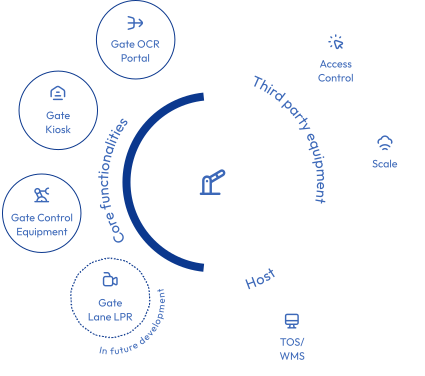
As part of the operateMybox ecosystem, GOS connects directly with TOS and Secure Release.
Together, they create a continuous digital chain — from slot booking until arrival of the container in the yard to billing.
Overview GOS Module
Looking ahead
The next generation of gate management starts here.
With the introduction of digital Secure Release and full slot-based truck scheduling, operateMybox GOS will be the foundation for autonomous gate operations — paving the way toward fully automated terminal entry and exit processes.

Scheduler - Intelligently assigning tasks
Optimizes job instructions, ensuring the most efficient allocation of CHEs. By intelligently assigning and sequencing tasks, the scheduler boosts productivity, minimizes empty moves and idle times, and reduces unnecessary emissions.
- API Service
- Solver Dispatcher
- Route/Traffic predictions (TTE Engine)
- Result Handler
Smart Planning & Operational Optimization
Optimizing terminal and depot operations through AI and data intelligence.
operateMybox Scheduler uses advanced AI-driven algorithms to optimally allocate job instructions to CHE.
When connected to the ADCS data lake — providing real-time insights from all equipment — the system applies machine learning to forecast driving and waiting times under current conditions, such as weather or time of day. This ensures that scheduling mirrors the true operating environment. As a result, it enables fully data-driven planning and automatically adjusts to changing circumstances.

Overview
operateMybox Scheduler is the AI-driven decision-making engine within the operateMybox ecosystem.
It connects directly with terminal and depot systems, analyzes historical and live data to support forecasting, and optimizes the assignment of job instructions.
The module includes scheduling solvers tailored to various terminal configurations, including SC, RTG, SC/ASC, and ATT/ASC environments. Its time travel estimation (TTE) engine predicts travel and waiting times based on real-time traffic and weather conditions. The module can also be integrated with commercial simulation tools to evaluate scenarios and terminal configurations.
Core Capabilities
Optimization Solver — Determines the optimal allocation, sequence, and pickup/drop-off times for job instructions while considering operational goals and constraints.
TTE Engine — Builds a road network from CHE telemetry and uses historical as well as real-time data to predict travel and waiting times based on current CHE positions.
Simulation Integration — Connects with commercial simulation software to support scenario testing and configuration analysis.
Collaborative Schedulers — Schedulers for different CHEs, e.g., SCs and ASCs, can collaborate to optimize handshakes.
Customizable Settings and Operational Strategies — Solvers can be tailored through a variety of configuration options and support different operational concepts, including pooling and cycling.
API-First Design — Offers a modern, developer-friendly API for seamless system integration.
Cross-Terminal Deployment — Supports a wide range of terminal layouts and CHE configurations.
Flexible Hosting — Available for on-premise or cloud-based deployment.
The Scheduler Difference
TOS-based scheduling often focuses on one container at a time, missing the bigger picture. operateMybox Scheduler uses AI-driven optimization to find the global optimum for all job instructions across the terminal.
By incorporating real-time insights and forecasts into the planning process, it enables proactive, efficient, and resource-optimized operations.
Your Benefits
Higher Productivity — Globally optimized schedules reduce bottlenecks and improve equipment utilization.
Reduced Waiting Times — Predictive insights help avoid queues at cranes, blocks, and interchange points.
Increased Service Reliability — More stable and predictable operations improve berth productivity and vessel turnaround times.
Faster Response to Disruptions — Real-time data enables immediate adjustments to weather changes, traffic peaks, or equipment issues.
Fewer Empty Moves — Coordinated planning minimizes unnecessary travel and increases operational efficiency.
Lower Fuel Consumption & Emissions — Smarter routes and fewer idle periods cut energy use and environmental impact.
Better Use of Existing Assets — AI-driven optimization unlocks performance gains without additional equipment.
Consistent Decision Quality — Automated scheduling eliminates manual variability and ensures objective, data-driven assignments.
Technology & Integration
Built as a modular “black box” optimization service, operateMybox Scheduler can serve multiple use cases – from waterside and yard dispatching to landside dispatching for rail and truck areas.
Tech Highlights
- API-based interface for TOS integration
- One unified API delivering a range of customized schedulers for every terminal configuration
- Flexible integration with leading commercial simulation platforms
- Flexible deployment in on-premise or cloud environments
- Results API enabling full transparency and traceability of all solver results
- Ultra scalable microservice architecture allowing to run several schedulers in parallel.
- TIC4.0-compatible cycle data for driving and waiting time predictions
How it fits into the modular ecosystem
operateMybox Scheduler seamlessly integrates with other operateMybox modules: with the TOS for operational scheduling and with ADCS to continuously learn from real operational data.
Continuous data feedback

Looking ahead
Ready to turn data into decisions?

ADCS - Automatic Data Collecting System
Combining datalogging, location tracking and data fusion to enhance operational insights and predictive capabilities.
- Datalogger
- Location
- Fusion
- Simulation
Automatic Data Collecting System
From data to decisions
operateMybox ADCS combines data logging, location tracking and data fusion to create deeper operational insights and predictive capabilities.
As the digital backbone of the operateMybox ecosystem, ADCS turns equipment and process data into actionable intelligence for smarter, more resilient terminal operations.

Overview
operateMybox ADCS is the data pipeline for the operateMybox platform. It connects field devices, operational systems, and analytics applications, continuously collecting and refining real-time data from cranes, straddle carriers, reach stackers, and yard systems. The product creates a unified data foundation that powers monitoring and predictive maintenance across all terminals.
It’s the enabler for AI-driven decision support – from real-time operations to long-term optimization – which lays the foundation for future applications as simulation-based optimization of transport and storage as well as real-time analytics and 3D visualization. The basis for ADCS is the publicly funded research project “Twin Sim.”
Core Capabilities
operateMybox ADCS is structured in modular building blocks. At the foundation lies the Datalogger Infrastructure & Data layer – the core module responsible for collecting and refining equipment and sensor data from the terminal.
Data Fusion — Combines operational data (TOS, SAP) with IIoT and sensor data in one stream.
Access Control — Digital authentication and usage control for equipment and personnel.
Data Logging (Datalogger) — Records up to 300 values per device (telemetry data), from GNSS location to engine and lifting data.
Location Tracking — Container and equipment geolocation for faster identification and reduced search times.
On top of this base, the next active development layers are Access, Location, and Fusion TOPX, which together provide secure device access, precise geolocation, and the merging of operational (TOS) and machine data.
The TwinSim Foundation
ADCS is the operational successor to the TwinSim research project, which developed a fully functional digital twin for container terminals (EUROGATE Technical Services + EGH IT + University of Hamburg). Building on this foundation, EUROGATE Technical Services and IT jointly developed the ADCS product.
TwinSim validated that real-time equipment data, when connected with TOS and ERP systems, can drive simulations, what-if analyses, and predictive maintenance. ADCS now operationalizes this concept — turning research into daily practice.
Key TwinSim Objectives Now Embedded in ADCS
- Centralized data platform for terminal operations
- Predictive maintenance based on IIoT sensor data
- Integration with Scheduler and Maintenance systems
The ADCS Difference
In modern terminals, data is everywhere – but often isolated. operateMybox ADCS breaks those silos by standardizing and connecting every information source, from field sensors to ERP systems.
This creates transparency, speeds up reactions to disruptions, and lays the foundation for automation, predictive maintenance, and energy efficiency.
Your Benefits
- Complete visibility of terminal equipment and status
- Faster fault detection and troubleshooting
- Reliable data for predictive models and scheduler optimizations
- Consistent integration of field data into TOS and BI tools
- Future-ready infrastructure for AI and digital-twin applications
- The Cloud Platform enables secure data sharing with customers
Technology & Integration
operateMybox ADCS is built on a hybrid cloud/on-premise setup, connecting industrial hardware, IoT systems, and data lakes via secure ETL pipelines.
This creates transparency, speeds up reactions to disruptions, and lays the foundation for automation, predictive maintenance, and energy efficiency.
-
Live Equipment Monitoring: Visualize and analyze machine data (engine status, lifting cycles, re-positioning).
-
Predictive Maintenance: Detect anomalies before failure using continuous sensor monitoring.
-
Location & Asset Tracking: Instantly locate containers or vehicles, reducing idle time.
-
Energy & Emission Analysis: Calculate CO₂ and fuel consumption per container move.
-
AWS Cloud architecture with Kinesis Streams, IoT Core, and S3 buckets
-
MQTT and Amazon-MQ brokers for field/TOS data transmission
-
OpenSearch dashboards for live visualization and to make the data available to users
-
AsyncAPI data description based on TIC 4.0 standard (we are among the first terminals to use this standard for all data in ADCS)
-
Real-time integration with TOS (TopX / COIN) and IIoT devices
-
Secure data access with defined roles and permissions
How it fits into the modular ecosystem
ADCS forms the “data nervous system” of the operateMybox system.
It feeds modules like Scheduler and Data/BI with accurate, standardized real-time data – ensuring consistency across terminals.
Example Data Flow

Looking ahead
Ready to connect your data for smarter operations?
The foundation of operateMybox ADCS is taking shape: Datalogger infrastructure, Access Control, Location Tracking, and Fusion with TOS (TOPX) are under active development—forming the data backbone for upcoming modules in the operateMybox ecosystem. On this base, ADCS will evolve into a full simulation and visualization environment—enabling terminals to monitor, analyze, simulate, and optimize operations in real time. With this roadmap, operateMybox ADCS advances from a data collection layer to a central intelligence hub—integrating IoT, AI, and simulation for self-learning, adaptive operations.

Billing - Automated invoicing
Automates the complete billing cycle with rate management, automatic invoicing, detailed analytics, and centralized control, reducing manual effort and errors.
- Rates
- Automatic Billing
- Detailed Analysis
- Centralization
Automate your terminal invoicing
From complex to clear
With operateMybox Billing, terminals can fully digitalize and automate their invoicing processes – from rate management and activity detection to reporting and controlling. The result: faster processes, fewer manual steps and a transparent, standardized billing flow for every service.
A seamless setup requires that the TOS delivers the corresponding process data.

Overview
Traditional billing systems are often fragmented, slow and hard to maintain.
operateMybox Billing brings automation, standardization and flexibility into one digital solution.
Core Capabilities
- Modern, modular, API-first architecture
- Contract & Rate Management (TMS) as single source of truth
- Event-based automation from TOS
- Standardized but flexible logic; handle terminals & customer specifics cleanly
- Unified and transparent billing logic across all terminals
- Reduced manual work
- Lower maintenance costs and improved data security
- Flexible deployment (Cloud / On-Premises)
- Ready for international terminal networks
The Billing Difference
In modern terminals, data is everywhere – but often isolated. operateMybox ADCS breaks those silos by standardizing and connecting every information source, from field sensors to ERP systems.
This creates transparency, speeds up reactions to disruptions, and lays the foundation for automation, predictive maintenance, and energy efficiency.
Your Benefits
Standardize & Scale — Unify billing logic across sites while allowing terminal/customer-specific rules.
Single source of truth — Rates & contracts in TMS; no duplicate maintenance.
Cloud or On-Prem — Deploy where you need it; vendor-agnostic cloud.
Automate Activities — Trigger billing from operational events; minimize manual work.
SAP/BI ready — Clean hand-off for revenue, credit notes, controlling & analytics.
Future-proof — Modern stack (e.g., Java/Spring Boot, PostgreSQL) & roadmap for AI-assists and simulations.
Technology & Integration
The Billing module is designed as a stand-alone yet fully integrable component within the operateMybox ecosystem. It replaces outdated legacy systems and introduces a future-proof architecture that supports both on-premise and cloud operation.
Built with a modern technology stack (Java/Spring Boot, PostgreSQL), it connects seamlessly with other systems such as TOS.
Tech Highlights
Integrated Contract & Rate Management (TMS): Manage rate agreements, side letters and special conditions in one place.
Event-based Automation: Automatically generate billing activities based on operational events from TOS or other interfaces.
Simulation & Forecast Tools: Calculate and simulate future rate adjustments, cost structures and volume developments.
Transparent Invoicing: Generate customer invoices, credit notes and performance reports directly from one data source.
SAP & BI Integration: Exchange financial data and KPIs with your controlling and analytics systems and SAP – and can also be linked to third-party TOS solutions like NAVIS.
How it fits into the modular ecosystem
As part of the modular operateMybox platform, the Billing module can be combined with GOS, TOS, Depot or Data modules – creating a seamless end-to-end process from operation to revenue.
Billing at the Core

Looking ahead
Ready to standardize and automate your billing processes?
The next generation of terminal invoicing is not only faster – it’s smarter.
With data-driven forecasts, AI-supported simulations and continuous development, operateMybox Billing keeps evolving along with your operations.

Depot - Container Management Processes
Oversees depot handling, container repairs (including reefer repair), and invoicing, ensuring transparent and efficient depot management processes.
- Depothandling
- Repair handling
- Reefer repair
- Invoicing
Digital Depot Operations
Smarter depots, faster turnaround.
operateMybox Depot digitalizes all processes in the container depot — from check-in and storage to repair, release, and billing — bringing automation, visibility, and efficiency to your depot operations.

Overview
The operateMybox Depot module is the digital backbone for container depots.
It unites container management, service execution, and accounting in one modular solution, connecting customers, trucking companies, and workshops through modern API and EDI interfaces.
Core Capabilities
Container Management — Digital container file, arrival/release handling, full lifecycle tracking
Accounting — Automated billing for handling, storage, and repairs
Interfaces & Connectivity — Modern API, EDI CODECO, COPARN, WESTIM and Reefer API, PDF & E-Mail
Services & Repairs — Estimate creation (IICL, CW, WWT) with photo capture and approval workflow
Mobile App Integration — Workshop card, inspection capture, and device control (Reachstacker / Empty Handler)
Administration & Roles — User permissions, audit trail, and automated archiving
The Depot Difference
Depot management is often fragmented across systems for storage, repairs, and billing. operateMybox Depot merges them into one streamlined environment, ensuring end-to-end transparency and automation.
It guarantees
-
Unified process from gate-in to billing
-
Unified process from gate-in to billing
-
Reduced manual effort and fewer errors
-
Shorter turnaround & higher asset utilization
-
Automated communication with customers & service partners
-
Ready integration with other operateMybox modules
Real-time insight into depot utilization, repair performance, and turnaround times — all in one place.
KPIs include:
-
Container dwell times and throughput
-
Storage and repair volume trends
-
Performance by customer or service type
-
Estimate acceptance rates
-
Workforce productivity and equipment usage
-
All metrics are accessible via customizable dashboards and exportable to BI systems.
operateMybox Depot digitizes every aspect of repair management — from inspection to approval.
Highlights:
-
Create and send repair estimates following IICL, CW, and WWT standards
-
Include photo documentation directly from the iOS app
-
Automated rule-based transmission of estimates to customers (manual or automatic modes)
-
Customer approval of repair orders via interface integration
-
Digital workshop card for internal teams and subcontractors
-
Transparent cost tracking per customer, period, and location
operateMybox Depot offers full accounting that automates depot revenue management.
Functions:
-
Price list management for handling, storage, labor, and repair rates per customer and site
-
Automatic invoice generation for repairs, handling, and storage
-
Service-provider billing and reconciliation
-
Custom EDI monitoring and reporting
Technology & Integration
-
Cloud-ready, API-first architecture
-
Full EDI coverage for import/export messages
-
Scalable – multiple depot locations can be managed within one cloud based application
The integration of CONROO, an intelligent truck appointment and yard management system, takes operateMybox Depot to the next level.
CONROO Integration — The Next Step in Automation

Truck arrivals are pre-announced and scheduled digitally via the CONROO app. Gate handling is automated, yard positions are assigned in real time, and all movements are synchronized with the depot system.
-
Reduced waiting times and congestion
-
Smoother yard capacity planning
-
Better resource utilization
-
Seamless data flow between drivers, dispatchers, and depot staff
The combination of operateMybox Depot + CONROO has already proven its value — enabling faster truck turnarounds and smarter yard management at REMAIN GmbH Container – Depot and Repair and ROLAND Umschlagsgesellschaft GmbH.


How it fits into the modular ecosystem
Integrated with the modules GOS, TOS, and Billing from the Terminals, the Depot module creates a continuous digital chain — from truck arrival to the Depot to invoicing.
One continuous digital chain
Looking ahead
Ready to digitalize your depot operations?
operateMybox Depot paves the way for predictive, automated depot management — connecting every stakeholder and process in one system.

CFS & Packing - Seamless workflow
Manages order and pricing, stuffing planning, and CFS operations, integrating invoicing for a seamless container freight station and packing workflow.
- Order-& Pricingmgmt.
- Order- & Stuffplaning
- Operation CFS & Packing
- Invoicing
Container Freight Station & Packing Operations
From quote to packed container — fully digital.
operateMybox CFS & Packing unifies commercial and operational workflows for Container Freight Stations and for seaworthy packing companies into one modern application: pricing, order intake, planning, execution on mobile devices, delivery, and invoicing.
A single all-in application restores operational reliability, standardizes processes across sites, reduces media breaks and errors, and meets e-invoicing compliance — improving competitiveness and customer experience.

Overview
A cloud-hosted, solution that digitizes paper-heavy CFS & Packing processes end-to-end. Admin teams work in a responsive web app; shop-floor staff use tablets/phones/scanners; data flows in real time via standardized interfaces.
The CFS & Packing Module is currently under development together with Eurogate Container Freight Station GmbH, SWOP Seaworthy Packing and 28Apps Software GmbH
Core Capabilities
Container Management — Digital container file, arrival/release handling, full lifecycle tracking Master data & interfaces. Customers, materials, resources, SAP creditors/debtors; automated interfaces to Conroo, SAP, CSM, customs/port authorities, Tableau/Infogate, OSIS (customer EDI), SmapOne.
Operations on Mobile — Guided workflows on mobile devices with validations, plausibility checks and digital file management
Invoicing — Automated invoice proposals from performed services; e-invoicing (XRechnung/ZUGFeRD)
Pricing — Base tariffs, customer tariffs, and offer-specific pricing with automation rules (e.g., offer > customer tariff > base tariff), tiers, validity schemes.
Planning — Shift & capacity planning with real-time status (operational board), continuous plan–actual checks, groundwork for smart algorithms.
Guided Operations
-
Workflow playbooks via SmapOne with real-time data exchange — ensuring process discipline without paper, including special-case logic (e.g., over-measures).
-
Plausibility checks prevent gaps and enforce required billing fields.
-
Resource tracking (labor, equipment, material) creates the data foundation for future AI-assisted planning.
Planning & Visibility
-
Shift board: assign orders to work steps, see live status and forecasted load for coming days.
-
Continuous plan–actual monitoring enables proactive decisions and future auto-capacity suggestions.
Interfaces & Compliance
-
CONROO (driver app / QR), SAP S/4HANA, CSM, customs/port authority systems, OSIS/EDI, Tableau, SmapOne.
-
Security & governance: DSGVO, KRITIS, automated testing, monitoring, clean error handling.
-
UX & Admin: Automated invoice proposals from performed services; e-invoicing (XRechnung/ZUGFeRD), SAP hand-off and digital archiving.
Future-Ready & Standard-Compliant
-
All relevant industry standards are already supported today; automation capabilities will continue to expand step by step.
-
Built on a modern, scalable architecture that is AI-ready by design – without positioning itself as a pure AI platform.
-
Prepared for future integration of large language models, standardized APIs, and advanced automation services as technologies mature and create measurable operational value.
E-Invoicing & Archiving
-
Design compliant with e-invoice mandate (XRechnung/ZUGFeRD) with SAP delivery; order e-file is archived post-billing.
How it fits into the modular ecosystem
CFS & Packing ties into GOS for gate automation, Billing for standardized invoicing logic/SAP, and Data/BI for KPIs (Tableau, internal reporting)
The focus of the module is on the physical core process: loading and unloading containers at the CFS. This is where goods are consolidated, distributed, checked, and containerized – for both export and import processes.
The CFS Gate is not a fixed cycle, but a flexibly integrable process point. It can be used before packing (Export) or after packing (Import).
All process steps are connected on the system side: Operational services are automatically incorporated into planning, transparency, and billing, without any media breaks. The result is an integrated, scalable CFS workflow that seamlessly combines physical processes and digital control.
Result

Looking ahead
Ready to digitize CFS & seaworthy packing - end to end?
operateMybox CFS & Packing paves the way for fully connected, data-driven CFS and packing operations — integrating planning, execution, and billing into one intelligent workflow.

Portal - Access to operational data
Provides self-service reporting, notifications, booking and release management, and dashboards—empowering customers and stakeholders with direct, real-time access to operational data.
- Self-Service Reporting
- Self-Service Notification
- Booking & Release
- Dashboards

Data - Analytics and Decision-making
Implements industry data standards (e.g., EDI/SMDG, TIC 4.0/DCSA), offers data sharing via DataZone, and enables “Data as a Service” for advanced analytics and decision-making.
- Standards (EDI/SMDG)
- New Standards (TIC 4.0/DCSA)
- Data Sharing (DataZone)
- Data as a Service

ECS - Equipment Control System
Orchestrates various types of Container Handling Equipment (CHE) through a modular, supplier-independent platform that ensures uniform communication. The ECS is responsible for executing, monitoring, and handling exceptions for orders, and manages communication handshakes between the equipment.
- Equipment communication
- Handshake management between equipment
- Order execution
- Status monitoring
Let’s shape the future of terminals together.